CMS DevOps Platform AWS EKS
completed
30-second summary
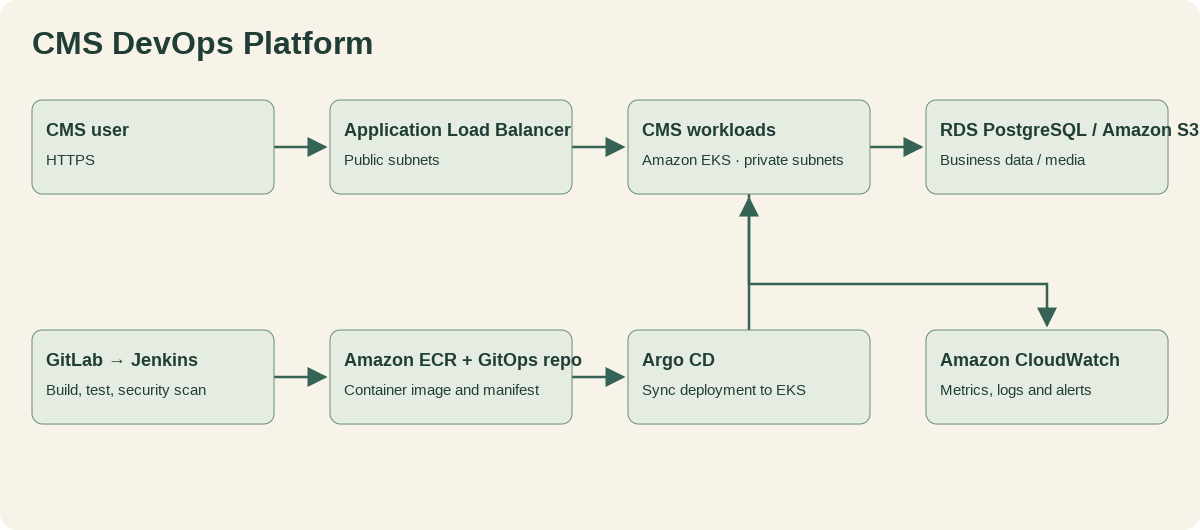
A platform that builds and automates delivery of a content management system (CMS) on Amazon EKS, combining Terraform infrastructure as code, Jenkins CI, Argo CD GitOps and monitoring.
Manual deployment made the CMS hard to stabilise and trace: inconsistent environments, many error-prone steps, hard-to-trace versions and uncontrolled rollback.
Sole author of the graduation project (platform design and delivery pipeline).
Context and problem
Graduation project of the VTI DevOps course, done by Duy alone. After submission VTI removed the whole AWS environment, so no running demo exists and there is no public repository; the only remaining material is the presentation slides.
Manual deployment made the CMS hard to stabilise and trace: inconsistent environments, many error-prone steps, hard-to-trace versions and uncontrolled rollback.
Individual role
Sole author of the graduation project (platform design and delivery pipeline).
Designed the whole chain described under architecture alone, from infrastructure as code to monitoring (per the slides).
Individual project; no team.
Architecture
Only the load balancer is public (HTTPS entry); workloads and the data tier sit in private subnets across two Availability Zones with 2 worker nodes. Request path: client, HTTPS, load balancer, frontend/backend; only the backend touches data, Redis reduces repeated PostgreSQL queries, and health probes gate traffic. Data: Redis (ElastiCache) cache plus a private Multi-AZ RDS PostgreSQL. Delivery: Jenkins CI, Amazon ECR (immutable images), Argo CD GitOps, EKS. Observability: CloudWatch plus Prometheus and Grafana.
Decisions and alternatives
One tool per responsibility (Terraform, Jenkins, ECR, Argo CD, EKS, RDS plus Redis, SonarQube plus Trivy, CloudWatch plus Grafana). Jenkins owns CI and Argo CD owns CD and reconciliation; image tags use the build number or commit SHA; rollback preferably by Git revert. Terraform state is stored centrally in an encrypted, versioned S3 backend, never in Git, and plan precedes apply. Containers run non-root with no secrets baked in. Rolling updates use a PodDisruptionBudget with startup, readiness and liveness probes. Security in depth: least-privilege IAM, public/private network split, security groups plus NetworkPolicy, secrets management. Dev, Staging, manual approval, Production, with the same image and different configuration.
The slides compare against a basic model: hand-made infrastructure, CI and CD in one script, the latest image tag, public workloads and databases, manual rollback and errors found by users.
Implementation
Kubernetes objects: Deployment, Service, ConfigMap, ServiceAccount, Ingress, NetworkPolicy and HPA in a dedicated namespace. Quality and security gates with SonarQube and Trivy stop the pipeline on failure.
Validation
The slides plan a five-minute live demo: a code change, git push, Jenkins, a new image, Argo CD, an EKS rollout and HTTP 200 on the health endpoint. The environment no longer exists, so nothing can be re-run.
Results and evidence
Self-reported on the slides: Terraform/VPC/EKS with 2 worker nodes; private Multi-AZ RDS plus Redis; Jenkins, ECR and Argo CD GitOps; private by default with a Pod security baseline; rolling update, probes and rollback; CloudWatch, Prometheus and Grafana. Independent evidence (screenshots, logs, repository): none yet. Metrics: not measured.
Limits and lessons — If I did it again
Incidents turned into operating rules: confirm the AWS identity and region before acting; add only the IAM permissions needed; after an interrupted terraform apply inspect the state and re-plan instead of deleting resources by hand; separate resource problems from access-entry problems on EKS.